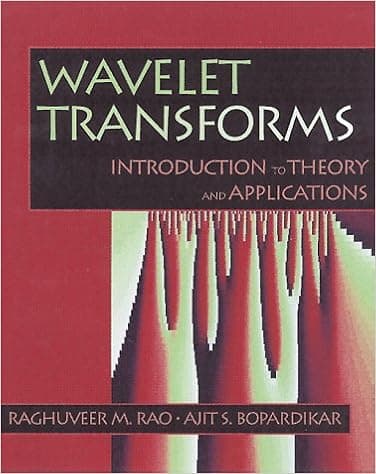
Wavelet Transforms: Introduction to Theory & Applications
From the Inside Flap The wavelet transform has been perhaps the most exciting development in the last decade to bring together researchers in several different fields such as signal processing, image processing, communications, computer science, and mathematics--to name a few. This book provides an introduction to wavelet transform theory and applications for engineers. The subject has been taught previously as part of several of our graduate courses in the Electrical Engineering Department at the Rochester Institute of Technology and is now being taught as a complete course. Most of the students who take the course are working engineers from local industries such as Eastman Kodak Company, Xerox Corporation, Harris, RF Communications, and so on. A challenge in teaching this audience has been to cast the material in a language familiar to engineers with a basic undergraduate degree while maintaining accuracy and rigor. Over the years we have been able to develop an approach using geometric analogies and filtering concepts to meet this challenge successfully. Our students and colleagues have been urging us to write a book that adopts such an approach because they find the material in the mathematically oriented books to be daunting and inaccessible. We have endeavored to keep the presentation in line with their exhortations. Application of the wavelet transform has almost come to be regarded as being synonymous with data compression. So it should come as no surprise that we have an extensive chapter on this application. However, there are properties of the wavelet transform that make it naturally suited for application in many other areas. It has been our desire for some time to bring out this fact. The reader will find a detailed chapter devoted to such applications.
- ASIN
- 0201634635
- Embedding
- CLIP ViT-L/14 · 768d
- Distance metric
- cosine
- Doc fetch
- 7mscache hitGET /v2/namespaces/amazon-products/documents/0201634635
- Similar query
- 35msnearest_to_id → /query
Doc fetch goes through Layer's Aerospike pull-through cache; cache hit served the row without touching turbopuffer. The similar query asks Layer for nearest neighbors of the stored product vector — queries don't go through the doc cache, so no cache header is set.
You might also like