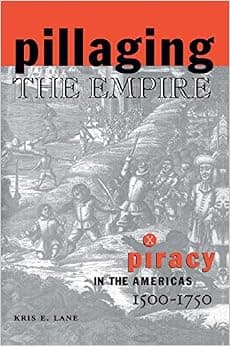
Pillaging the Empire: Piracy in the Americas, 1500-1750 (Latin American Realities)
From Library Journal Pirates followed Columbus to the New World. At first, the French, English, and Dutch governments dispatched pirates and privateers to plunder Spanish ships and settlements. Soon pirates became "independent agents" and plundered on their own, with Spanish shipping from the New World to Europe making easy pickings. Lane (history, William and Mary Coll.) has written widely on the histories of piracy and witchcraft and has carefully studied the pirates' effect on the Spanish carrying trade. These were not the pirates of Treasure Island but murdering, pitiless buccaneers. Lane tells the stories without the myths, discussing such well-known pirates as Francis Drake, Henry Morgan, Piet Heyn, and Ann Bonn plus several lesser-known brigands, and he includes helpful discussions of shipbuilding, food, navigation, and more. This is a well-written and important scholarly examination of an often romanticized subject and the first of its kind in English. Recommended for all maritime history collections.?Stanley Itkin, Hillside P.L., New Hyde Park, NYCopyright 1998 Reed Business Information, Inc.
- ASIN
- 0765602571
- Embedding
- CLIP ViT-L/14 · 768d
- Distance metric
- cosine
- Doc fetch
- 11mscache hitGET /v2/namespaces/amazon-products/documents/0765602571
- Similar query
- 26msnearest_to_id → /query
Doc fetch goes through Layer's Aerospike pull-through cache; cache hit served the row without touching turbopuffer. The similar query asks Layer for nearest neighbors of the stored product vector — queries don't go through the doc cache, so no cache header is set.
You might also like